
"Innovation is a cycle punctuated by moments of inspiration: build something, observe what it does, understand where information is being lost, ideate and change it. "
Aaron Bernstein
Our tradeshow demonstrations can make our underlying technology look deceptively simple. Anatomy moves, and our systems follow it without needing invasive arrays or manual registration. That simplicity represents many years of technical work and innovation, much of it driven by Dr. Aaron Bernstein, VISIE co-founder, chief technology officer and co-inventor of its core technology. He has drawn on an unusual background, grounded heavily in optical physics, to solve much of the complexity.
A couple of questions have shaped his career to date: how do you make difficult measurement reliable? And how do you find the simplest, most robust way of extracting the information you need? They also explain why VISIE’s tech is so difficult to reproduce.
Bernstein’s initial training was as an optical physicist; he earned his PhD in Optical Sciences and Engineering in 2004, focused on optical instrumentation for extreme physical environments. He then went on to work in several demanding research settings where failure was expensive and reliable measurement was essential. At the University of Texas, he served as a scientist and deputy director of a research group that built what was, at the time, the world’s most powerful laser. He led scientists and students working with multi-million-dollar systems and served as principal investigator on large-scale experiments at national laboratories including Sandia and Lawrence Livermore.
Laser based fusion and experimental physics
The work ranged from laser-based fusion to experiments recreating the pressure and temperature conditions of the Earth’s core, experiments that, due to their size, often only had a single chance of success. That experience did not lead neatly or predictably to surgical technology. But it did reinforce the instinct behind the questions; choose techniques you can test and trust, even if that means innovating new ones. Bernstein selected his measurement methods for his PhD and in the lab for exactly that reason, and that same preference for robustness would later help shape the technology behind VISIE.
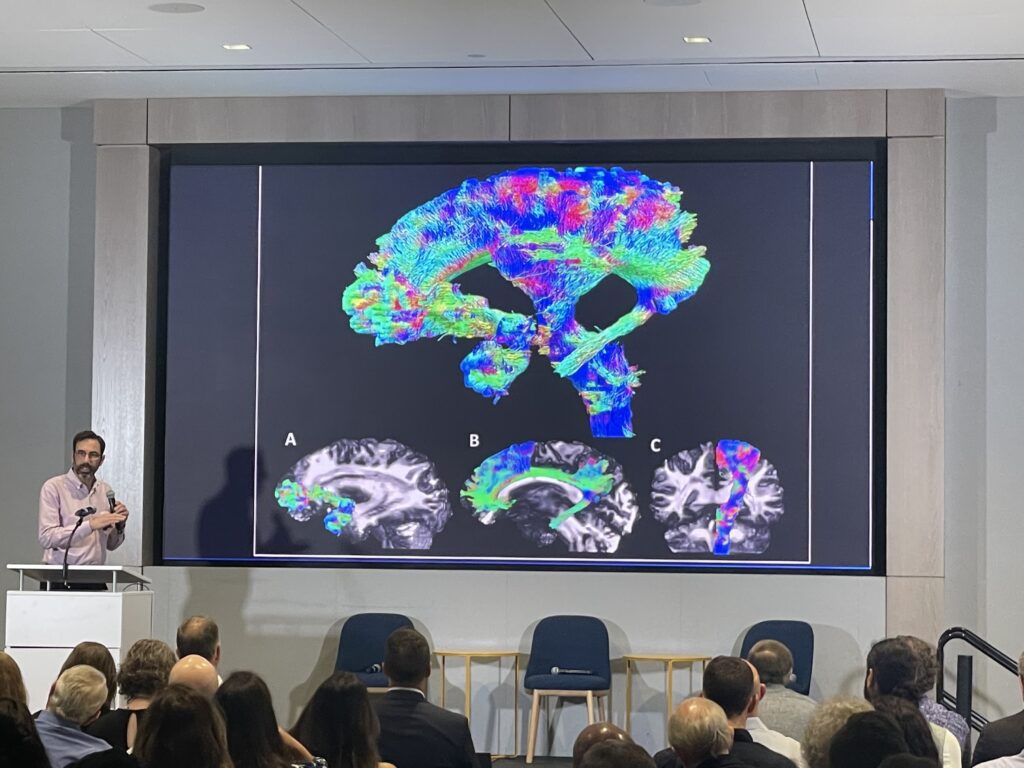
By 2017, he was already the principal investigator on major experimental-physics projects where he managed a team of scientists. But he chose to leave to focus fully on medicine. The motivation was more personal than technical: he wanted to help people. The pivot started at a party, where a neuroscientist described a challenge in pediatric epilepsy surgery: once the skull is opened, the brain moves and existing tools can no longer track it. Bernstein recognized it instantly as the same kind of measurement problem he’d been solving for years, just one with potentially a higher stakes impact.
Iterative Problem Solving
Another characteristic that he developed early on has been equally important: he is an iterative problem solver. He builds, tests, observes and changes. An idea that works becomes the starting point for the next iteration. That approach is what led to what was to become the VISIE scanner.
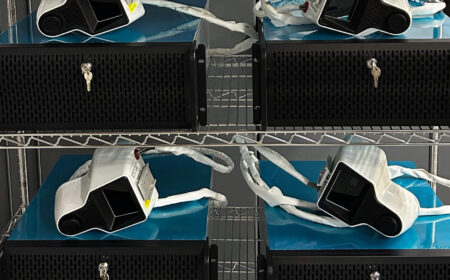
Today’s technology started as a hobby. Bernstein had seen an existing approach to 3D scanning and knew that he could improve it. He started by stripping back the problem. Early prototypes built at his home used flashlights. From those experiments came the realizations about the geometry and illumination he needed. That idea ultimately evolved into VISIE’s current hardware.
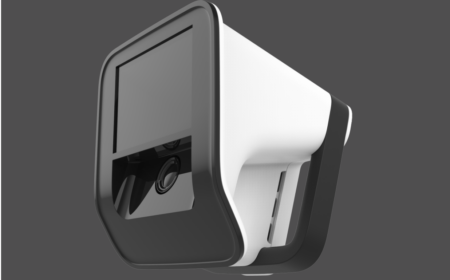
Over time he was able to rethink, reengineer and improve the underlying optical architecture. As a result, VISIE controls all of the optical stack at the heart of its system and does not depend on conventional off the shelf products for its system. This also means that key technical decisions are driven by VISIE’s own requirements rather than what’s available on the market.
This philosophy has continued as the technology has evolved. Since the company’s establishment, Bernstein and the VISIE team have regularly changed and improved every aspect of how the scanner captures and processes information.
One breakthrough made it possible for the scanner to perform scans hand-held, by capturing the data in a very short amount of time. A series of breakthroughs shortened the time required between scans. More recently, Bernstein reworked the scanning and computational path so that the system could produce and process 3D scans at over 100 Hz, streaming 3D navigation data for very robust tracking. Each iteration built on what the team had learned before, gradually enhancing what the system was capable of.
Accumulated enhancements
All of these accumulated enhancements matter because the specifications used to market 3D scanning systems can be misleadingly simple. A high camera or acquisition rate does not necessarily mean that a system is producing a complete 3D scan at that rate. Dense sampling does not necessarily mean high optical resolution. And generating detailed 3D information becomes considerably harder when the object being scanned is moving. Bernstein and the VISIE team have spent years working at the intersection of these challenges: balancing density, accuracy, speed and motion.
Bernstein himself describes innovation as a cycle punctuated by moments of inspiration: build something, observe what it does, understand where information is being lost, ideate and change it. Many of VISIE’s most important advances have arrived that way, one insight building on another. Many ideas that could not be pursued immediately, became crucial to solving a future challenge.
None of this happened by taking existing scanners and adapting them for the OR. VISIE’s tech comes from building from the ground up for a surgical environment; optical physics, experimental instrumentation, first-principles design and years of iteration around one question: how can you to get reliable 3D data in difficult conditions – and as the best tool for the surgeon? That lineage is what makes the system hard to reproduce. The advantage has never been a single breakthrough or components. It’s the accumulated knowledge of how the optics, data capture and computation work together, built by a team that has spent years learning exactly where and how each can be pushed further.
And that’s why, on the tradeshow floor, all of that work disappears into something that looks effortless.